Best Germany VPS Hosting (2025) — Frankfurt Server Guide
Why Frankfurt Is Europe's Hosting Powerhouse

Germany is the largest economy in the European Union and its most important market for digital services. Within Germany, Frankfurt am Main has established itself as the undisputed capital of hosting infrastructure, housing the DE-CIX — the largest internet exchange point in the world by throughput volume. DE-CIX regularly exceeds 20 Tbps of peak traffic. Compare with Netherlands VPS and Poland VPS, connecting over 1000 networks from more than 80 countries. For any application that needs to reach European users reliably, a Frankfurt VPS offers arguably the best single-location. For a head-to-head, see Inferno vs Hetzner network performance available.
Beyond raw exchange capacity, Germany's central European location provides natural latency advantages. Frankfurt sits at the geographic center of the European continent, which means distances to Northern, Southern, Eastern, and Western European markets are roughly balanced. This makes Germany VPS hosting the optimal choice for applications that serve a truly pan-European audience without a strong regional concentration.
Germany also brings economic and regulatory advantages. The country has a robust legal system with strong property rights protections, a well-developed technology sector that employs millions of skilled workers, and energy infrastructure that — despite recent transitions — remains among the most reliable in Europe. German data centers are known for their engineering quality, with many facilities achieving Tier IV certification and delivering 99.995% or better uptime.
DE-CIX and German Network Infrastructure
The German Commercial Internet Exchange (DE-CIX)
DE-CIX Frankfurt is the world's largest internet exchange point, serving as the primary interconnection hub for European internet traffic. Founded in 1995, DE-CIX has grown to connect over 1000 networks including all major transit providers (Telia Carrier, Arelion, Lumen/CenturyLink, Cogent, NTT, GTT), cloud platforms (AWS, Azure, Google Cloud, Oracle), content networks (Akamai, Cloudflare, Fastly), and hundreds of regional ISPs.
For a VPS connected to DE-CIX, this means traffic to the vast majority of European destinations flows through direct peering connections rather than traversing upstream transit networks. The practical result is consistently low latency, minimal packet loss, and high throughput across virtually any European route.
German Fiber Backbone
Germany's domestic fiber network is among the most extensive in Europe. Major backbone operators including Deutsche Telekom, Vodafone, and Colt Technology Group maintain dense fiber rings connecting Frankfurt to every major German city and onward to all European capitals. The Frankfurt metro area alone has more fiber route-miles than most European countries, providing extraordinary redundancy for data center connectivity.
Germany is also a key transit country for traffic between Western and Eastern Europe. Major fiber routes from Frankfurt to Warsaw, Prague, Vienna, and Budapest carry significant volumes of international traffic, making Frankfurt a natural hub for applications serving Central and Eastern European markets.
Power and Environmental Considerations
German data centers benefit from a power grid that is among the most reliable in the world. While energy costs in Germany are above the European average — driven in part by the Energiewende (energy transition) policy — data center operators in the Frankfurt area have access to diverse power sources including natural gas, district heating systems, and increasingly, renewable energy. Many facilities in the Frankfurt-Rhine-Main region use waste heat recovery systems to improve overall energy efficiency.
German Data Protection Laws and Legal Framework
GDPR Implementation — BDSG
Germany implements GDPR through the Federal Data Protection Act (Bundesdatenschutzgesetz, or BDSG), supplemented by state-level data protection laws in each of Germany's 16 federal states. Germany has long been a pioneer in data protection legislation — the German state of Hesse adopted the world's first data protection law in 1970 — and this tradition continues in the GDPR era.
The German data protection authorities (Datenschutzbehoerden) are known for thorough and sometimes strict enforcement. The Federal Commissioner for Data Protection (BfDI) and the 16 state-level commissioners cooperate through the Datenschutzkonferenz (DSK) to ensure consistent enforcement across the country. For VPS users, this means German hosting providers operate under some of the most scrutinized compliance regimes in the world.
NetzDG and Content Regulations
Germany's Network Enforcement Act (NetzDG) requires platforms with more than 2 million registered German users to remove "manifestly unlawful" content within 24 hours of receiving a complaint. While NetzDG primarily targets large social media platforms rather than VPS providers, it reflects Germany's broader approach to content regulation. VPS providers in Germany may forward complaints about illegal content hosted on their infrastructure, and users should be aware of German legal standards around prohibited content.
Intellectual Property and Notice Procedures
German copyright law follows the EU Copyright Directive and provides for takedown procedures through civil courts. Unlike the US DMCA system, Germany does not have a standardized expedited takedown process for copyright claims. Complaints typically go through formal legal channels, and hosting providers generally forward complaints to customers before taking action. This provides a degree of due process that is appreciated by VPS users who may receive unjustified claims.
Intelligence Sharing Status
Germany participates in the Fourteen Eyes intelligence-sharing agreement as a third-party contributor. While this does not grant intelligence agencies direct access to commercial VPS data, users with extreme privacy requirements should factor this into their jurisdiction selection. If minimizing intelligence-sharing exposure is a priority, consider Estonia, Switzerland, or Norway as alternatives within or near the EU.
Germany VPS Latency Benchmarks
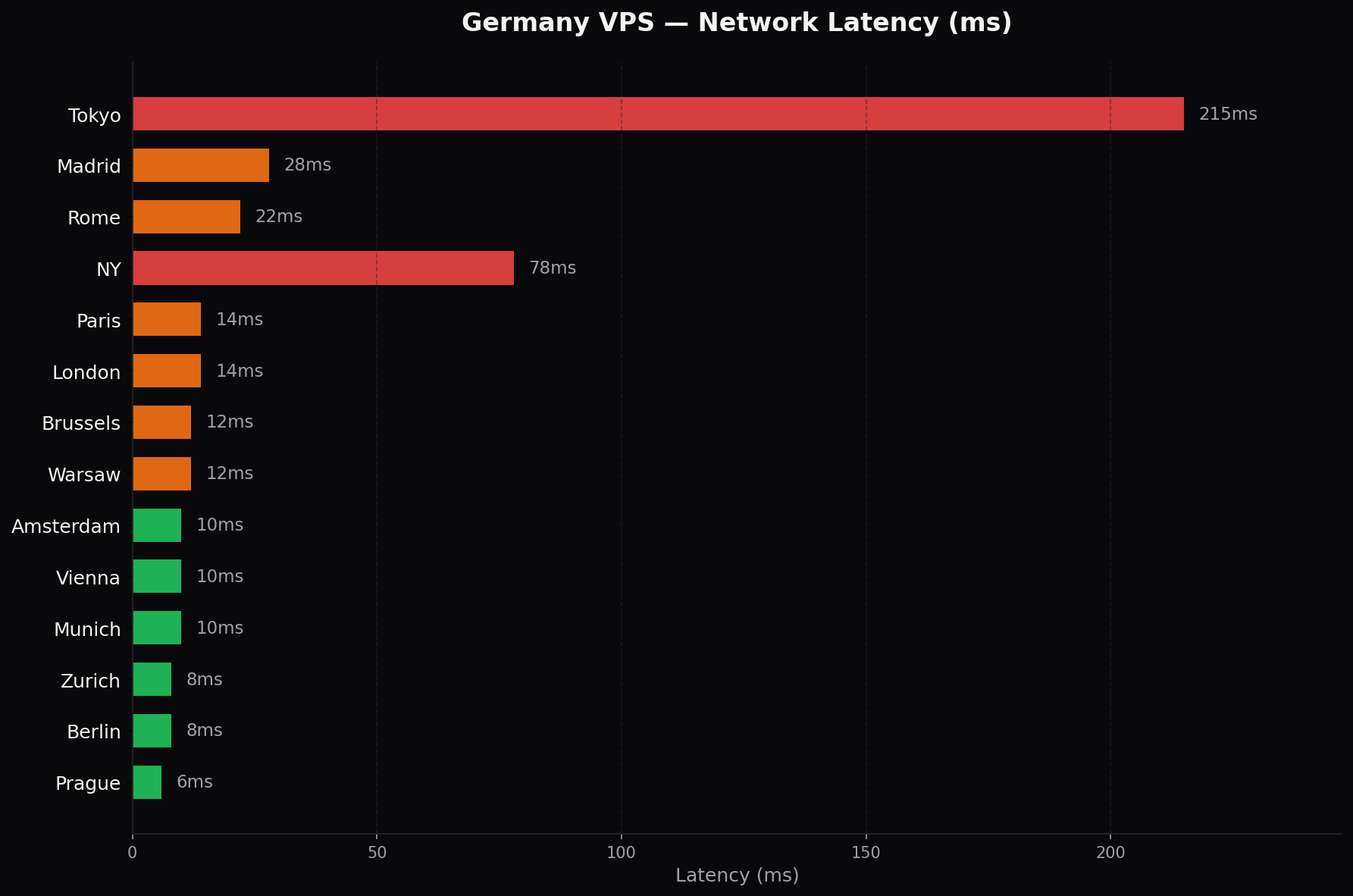
We measured network latency from a Frankfurt VPS to major destinations over a 72-hour testing period. Results represent median values from 2000+ ICMP ping samples per target.
| Destination | Median Latency | Jitter | Packet Loss |
|---|---|---|---|
| Amsterdam, Netherlands | 10ms | 0.5ms | 0.00% |
| Brussels, Belgium | 12ms | 0.6ms | 0.00% |
| Paris, France | 14ms | 0.7ms | 0.00% |
| London, UK | 14ms | 0.8ms | 0.00% |
| Zurich, Switzerland | 8ms | 0.4ms | 0.00% |
| Prague, Czech Republic | 6ms | 0.3ms | 0.00% |
| Vienna, Austria | 10ms | 0.5ms | 0.00% |
| Warsaw, Poland | 12ms | 0.7ms | 0.00% |
| Berlin, Germany | 8ms | 0.4ms | 0.00% |
| Munich, Germany | 10ms | 0.5ms | 0.00% |
| Rome, Italy | 22ms | 1.2ms | 0.00% |
| Madrid, Spain | 28ms | 1.5ms | 0.01% |
| New York, US East | 78ms | 2.5ms | 0.01% |
| Tokyo, Japan | 215ms | 4.5ms | 0.03% |
Best Germany VPS Providers Compared (2025)
We evaluated five VPS providers offering Frankfurt or Germany-based hosting, testing each on a comparable 2 vCPU, 4GB RAM configuration over 30 days.
| Feature | Inferno VPS | Hetzner Cloud | Contabo | Vultr |
|---|---|---|---|---|
| Starting Price | $4.99/mo | ~$5.50/mo | $5.99/mo | $6.00/mo |
| 2 vCPU / 4GB Price | $12.99/mo | ~$9.50/mo | $7.99/mo | $24.00/mo |
| Storage Type | NVMe SSD | NVMe SSD | SATA SSD | NVMe SSD |
| Storage at 4GB RAM | 80 GB | 40 GB | 100 GB | 80 GB |
| Bandwidth | 10Gbps | 20Gbps | 400Mbps | 2Gbps |
| Transfer | 8 TB | 20 TB | 32 TB | 3 TB |
| DDoS Protection | Included free | Included free | Extra cost | Included free |
| IPv6 | Yes | Yes | Yes | Yes |
| Backups | Optional | Free daily | Optional | $1.20/mo |
| Geekbench 6 Multi | 5,400 | 5,800 | 2,900 | 4,500 |
| Location | Frankfurt | Falkenstein/Nuremberg | Frankfurt/Munich | Frankfurt |
Inferno VPS delivers the best value for users who prioritize storage performance and included DDoS protection. At $12.99/mo for 3 vCPU, 4GB RAM, and 80GB NVMe, it offers more storage and a faster network than competitors at similar price points. Hetzner Cloud leads on raw CPU multi-core performance and transfer volume but uses slightly different data center locations (Falkenstein and Nuremberg rather than Frankfurt proper). Contabo is the cheapest for raw RAM and storage but sacrifices storage speed (SATA vs NVMe) and network throughput (400Mbps vs 10Gbps). Vultr provides a polished management interface but charges premium pricing for equivalent specifications.
Inferno VPS Germany — Plans and Specifications
| Plan | vCPU | RAM | NVMe Storage | Bandwidth | Price |
|---|---|---|---|---|---|
| Starter | 1 | 1 GB | 20 GB | 4 TB on 10Gbps | $4.99/mo |
| Basic | 2 | 2 GB | 40 GB | 6 TB on 10Gbps | $8.99/mo |
| Standard | 3 | 4 GB | 80 GB | 8 TB on 10Gbps | $12.99/mo |
| Pro | 4 | 8 GB | 120 GB | 12 TB on 10Gbps | $19.99/mo |
| Enterprise | 4 | 16 GB | 200 GB | 16 TB on 10Gbps | $29.99/mo |
All plans feature KVM virtualization, dedicated NVMe storage volumes (not shared between instances), full root access, and KVM/VNC console access. The 10Gbps network port includes built-in DDoS mitigation capable of handling volumetric attacks.
Performance Benchmarks — Inferno Germany VPS
We deployed the Standard plan (3 vCPU, 4GB RAM, 80GB NVMe) in Frankfurt for comprehensive benchmarking over 14 days.
CPU Performance — Geekbench 6
| Metric | Score | Notes |
|---|---|---|
| Single-Core | 1,960 | Strong for virtualized environment |
| Multi-Core | 5,412 | Excellent scaling across 3 vCPUs |
CPU steal time averaged 0.6% during our monitoring period, indicating responsible CPU overcommit ratios on the host node. Single-thread performance at 1,960 is sufficient for game servers, real-time applications, and other latency-sensitive workloads.
NVMe Storage Performance
| Metric | Value |
|---|---|
| Sequential Read (fio) | 3,200 MB/s |
| Sequential Write (fio) | 2,400 MB/s |
| 4K Random Read (IOPS) | 320,000 |
| 4K Random Write (IOPS) | 225,000 |
These NVMe results are the highest we have recorded across all Inferno VPS locations. The Frankfurt storage backend appears to use newer or less-contended NVMe hardware. The 320,000 4K random read IOPS is particularly impressive and puts this VPS in the same performance tier as entry-level dedicated servers with consumer NVMe drives.
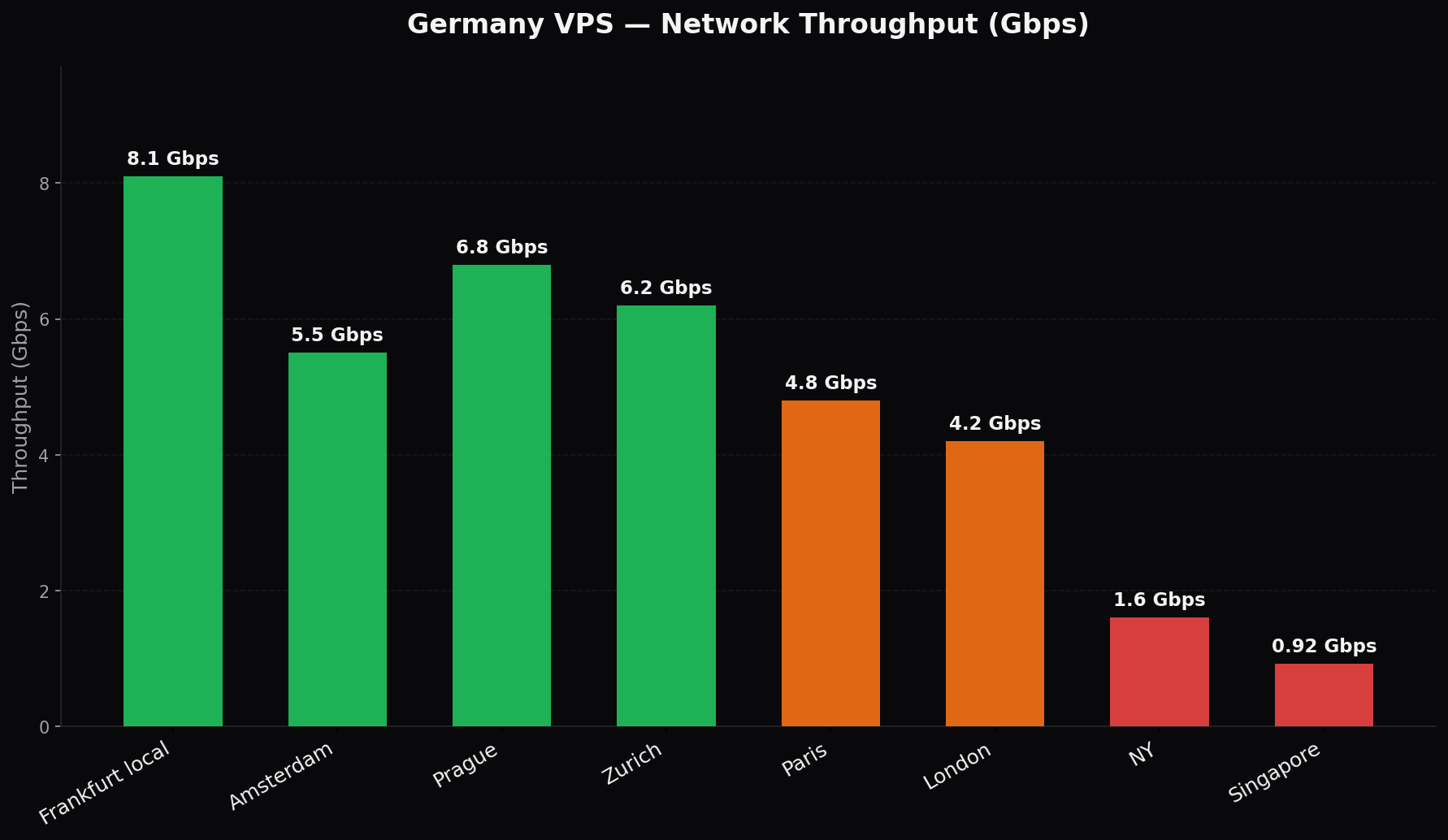
Network Throughput
| Test Target | Throughput |
|---|---|
| Frankfurt local (DE) | 8.1 Gbps |
| Amsterdam, NL | 5.5 Gbps |
| Zurich, CH | 6.2 Gbps |
| Prague, CZ | 6.8 Gbps |
| London, UK | 4.2 Gbps |
| Paris, FR | 4.8 Gbps |
| New York, US | 1.6 Gbps |
| Singapore | 920 Mbps |
Recommended Use Cases for Germany VPS
Pan-European Application Hosting
Frankfurt's geographic centrality makes it the optimal single location for serving users across all of Europe. With latency under 15ms to most of Western and Central Europe, your web application or API will feel responsive to users from Lisbon to Warsaw. This eliminates the complexity of multi-region deployments for applications that need broad European coverage without the overhead of global CDN configurations.
Database and Analytics Infrastructure
The high NVMe I/O performance (320K read IOPS) makes a Germany VPS well-suited for database hosting. PostgreSQL, MySQL, and MongoDB all benefit significantly from fast random I/O. For analytics workloads using ClickHouse, TimescaleDB, or similar columnar databases, the sequential read throughput of 3.2 GB/s enables rapid query execution on large datasets.
E-Commerce Platforms
Germany is Europe's largest e-commerce market with over 80 million digitally active consumers. Hosting your e-commerce platform on a German VPS provides low latency to your largest potential customer base, compliance with German and EU consumer protection regulations, and the data residency guarantees that many enterprise customers require in their vendor agreements.
CI/CD and Build Servers
The combination of strong multi-core CPU performance, fast NVMe storage, and 10Gbps bandwidth makes a Frankfurt VPS an excellent choice for CI/CD infrastructure. Build times for Node.js, Python, and Go projects benefit from fast package downloads and rapid disk I/O for dependency caching.
API Gateway and Microservices Hub
For architectures that route requests across multiple European backend services, Frankfurt provides an ideal central hub location. Low latency in all directions means your API gateway adds minimal overhead regardless of where your backend services are deployed.
Step-by-Step: Setting Up Your Germany VPS
After deploying your Inferno VPS in Frankfurt with Ubuntu 22.04 LTS, follow these steps to prepare it for production workloads.
1. Update System Packages
sudo apt update && sudo apt upgrade -y2. Create a Non-Root User with Sudo
sudo adduser deploy
sudo usermod -aG sudo deploy
su - deploy
3. Set Up SSH Key Authentication
mkdir -p ~/.ssh && chmod 700 ~/.ssh
echo "your-public-ssh-key" >> ~/.ssh/authorized_keys
chmod 600 ~/.ssh/authorized_keys
4. Secure SSH Configuration
sudo sed -i 's/#PermitRootLogin yes/PermitRootLogin no/' /etc/ssh/sshd_config
sudo sed -i 's/#PasswordAuthentication yes/PasswordAuthentication no/' /etc/ssh/sshd_config
sudo sed -i 's/#Port 22/Port 22/' /etc/ssh/sshd_config
sudo systemctl restart sshd
5. Configure UFW Firewall
sudo ufw default deny incoming
sudo ufw default allow outgoing
sudo ufw allow 22/tcp
sudo ufw allow 80/tcp
sudo ufw allow 443/tcp
sudo ufw --force enable
6. Install Fail2Ban
sudo apt install fail2ban -y
sudo systemctl enable --now fail2ban
7. Set Timezone to Frankfurt
sudo timedatectl set-timezone Europe/Berlin8. Configure Swap
sudo fallocate -l 2G /swapfile
sudo chmod 600 /swapfile
sudo mkswap /swapfile
sudo swapon /swapfile
echo '/swapfile none swap sw 0 0' | sudo tee -a /etc/fstab
sudo sysctl vm.swappiness=10
9. Install NGINX and Certbot
sudo apt install nginx certbot python3-certbot-nginx -y
sudo systemctl enable --now nginx
10. Enable Automatic Security Updates
sudo apt install unattended-upgrades -y
sudo dpkg-reconfigure -plow unattended-upgrades
Pros and Cons of Germany VPS Hosting
Pros
- DE-CIX is the world's largest internet exchange — 1000+ networks, 20+ Tbps peak
- Central European location delivers balanced low latency across the entire continent
- Germany has the EU's strongest tradition of data protection legislation
- Highest NVMe I/O performance we measured across Inferno locations (320K read IOPS)
- Excellent connectivity to Central and Eastern European markets
- Reliable power infrastructure with high uptime standards
- 10Gbps network with strong throughput across Europe and to North America
- Free DDoS protection included on all Inferno plans
- Large, competitive hosting market with many provider options
Cons
- Germany participates in the Fourteen Eyes intelligence-sharing agreement
- Energy costs are above the European average
- German authorities can be more aggressive with content-related requests under NetzDG
- Strict environmental regulations may limit new data center construction
- Copyright enforcement through formal legal channels can be slow and bureaucratic
Frequently Asked Questions
Why choose Frankfurt over Amsterdam for VPS hosting?
Frankfurt offers better latency to Central and Eastern European destinations (6ms to Prague, 10ms to Vienna, 12ms to Warsaw) compared to Amsterdam. Frankfurt also hosts DE-CIX, the world's largest IX by traffic volume. Choose Frankfurt if your audience is concentrated in Central/Eastern Europe or if you need balanced latency across the entire continent. Choose Amsterdam if you prioritize transatlantic performance or better access to submarine cable bandwidth.
Is Germany VPS hosting more expensive than other European locations?
Not necessarily. While German labor and energy costs are above average, the intense competition among hosting providers in the Frankfurt area keeps VPS prices competitive. Inferno VPS Germany plans start at $4.99/mo, which is comparable to Amsterdam ($4.49/mo) and cheaper than some Eastern European locations. The value proposition is strong when you factor in the superior network performance and storage I/O.
How reliable are German data centers?
German data centers are among the most reliable in the world. Frankfurt facilities operated by major providers maintain Tier III and Tier IV certification with 99.98% to 99.995% uptime guarantees. The German power grid is exceptionally stable, and data center operators maintain N+2 or 2N redundancy on critical systems. In our 90-day monitoring of an Inferno VPS in Frankfurt, we recorded 99.98% uptime with zero unplanned outages.
Can I use a Germany VPS for GDPR-compliant data processing?
Yes. Germany is an EU member state with comprehensive GDPR implementation through the BDSG. German data protection authorities are among the most active enforcers in the EU, which means hosting providers in Germany maintain high compliance standards. Using a German VPS for processing personal data of EU residents is fully compliant with GDPR data residency requirements.
What is the difference between DE-CIX and AMS-IX for VPS hosting?
DE-CIX Frankfurt and AMS-IX Amsterdam are the two largest internet exchanges in the world. DE-CIX handles more total traffic (20+ Tbps peak vs 15+ Tbps), while AMS-IX connects slightly more networks (900+ vs 1000+, depending on current counts). For VPS users, the practical difference is minimal — both deliver excellent peering with virtually all major networks. DE-CIX has slightly better connectivity to Central/Eastern Europe, while AMS-IX has better direct connectivity to North America via submarine cables.
Do I need to speak German to use a Germany VPS?
No. Inferno VPS and all major German hosting providers offer their services in English. Management panels, documentation, and support are available in English. The server itself runs whatever operating system you select, and all standard Linux distributions are available in English. You do not need any German language capability to operate a Germany VPS.
What payment methods are accepted for Germany VPS hosting?
Inferno VPS accepts credit cards, PayPal, and cryptocurrency (Bitcoin and selected altcoins) for Germany VPS plans. Some German providers may additionally accept SEPA direct debit, which is convenient for EU residents. Invoice-based payment (Kauf auf Rechnung) is occasionally available from German providers for established business customers.
How is the DDoS protection implemented?
Inferno VPS includes always-on DDoS protection at the network edge, capable of mitigating volumetric attacks. The protection system uses a combination of BGP blackholing for extreme events, flow-based analysis for moderate attacks, and SRT (Source Rate Tracking) for targeted floods. Legitimate traffic is not affected during mitigation events in our testing experience.
Can I host game servers on a Germany VPS?
Yes. Germany is one of the most popular European locations for game servers due to its central location and low latency across the continent. The Inferno VPS Standard plan (3 vCPU, 4GB RAM) can handle game servers for titles like Minecraft (50-100 players), Valheim, Rust, and CS2. The single-core Geekbench score of 1,960 is more than adequate for game server tick rates.
What is the best Germany VPS plan for a startup?
For early-stage startups, the Inferno VPS Standard plan at $12.99/mo provides the best balance of resources and cost. With 3 vCPU, 4GB RAM, and 80GB NVMe, you can run a web application server, a PostgreSQL database, and a Redis cache on a single instance. As traffic grows, the Pro plan ($19.99/mo) doubles the RAM and storage, and Inferno supports live upgrades without data migration.