Best NVMe VPS Europe (2025) — Speed Benchmarks & Comparison
Why NVMe Storage Matters for VPS Performance
NVMe represents a fundamental shift. For a head-to-head, see Inferno vs Hetzner in storage technology compared to traditional SATA SSDs and HDDs. While SATA III is limited to ~550 MB/s. Top NVMe locations include Germany, Netherlands, and Finland due to the interface bottleneck, NVMe drives connect directly to the PCIe bus and can deliver sustained throughput exceeding 7,000 MB/s on modern Gen4 hardware. The latency improvement is equally significant: NVMe drives achieve microsecond-level access times compared to milliseconds for SATA SSDs.
For VPS users, this performance gap has direct, measurable impact on real workloads. Database query latency drops by 40-60%. For Docker on NVMe, see VPS for Docker when moving from SATA SSD to NVMe. Application boot times, file serving speeds, container startup times, and build pipeline duration all improve substantially. If your VPS runs PostgreSQL, MySQL, Elasticsearch, Redis with disk persistence, or any application with heavy I/O patterns, NVMe is not a luxury — it is a necessity for acceptable performance.
However, not all NVMe VPS providers deliver equal performance. The underlying hardware, storage architecture (dedicated vs shared), I/O throttling policies, and hypervisor overhead all affect the real-world speed you experience. This guide tests six major European VPS providers with identical workloads to determine which delivers the best NVMe performance per dollar.
Benchmark Methodology
All benchmarks were conducted in May 2025 using freshly provisioned instances with the closest matching specifications across providers. Each provider was tested with a 4 vCPU / 8 GB RAM configuration (or the nearest equivalent) running Ubuntu 24.04 LTS. Tests were executed three times, and the median value was recorded. No other workloads were running on the instances during testing.
Testing Tools
fio (Flexible I/O Tester) was used for storage benchmarks with the following profiles: sequential read/write using 1 MB block size with libaio engine and iodepth=64, and random 4K read/write using 4 KB block size with libaio engine and iodepth=32. Direct=1 and sync=0 flags were set to bypass page cache. Geekbench 6 measured CPU performance. iperf3 measured network throughput to a reference server in Frankfurt.
Fairness Considerations
Providers use different CPU generations, storage architectures, and I/O throttling policies. We report raw numbers as measured, but include notes on architectural differences that explain performance variations. Price-to-performance ratios normalize results against monthly cost to account for pricing differences.
Provider Profiles
1. Inferno VPS
Inferno VPS operates KVM virtualization on AMD Ryzen 9 7950X processors with dedicated NVMe storage allocated per instance. Their infrastructure runs across six European data centers. All plans include DDoS protection, free weekly snapshots, and both hourly and monthly billing. Inferno distinguishes itself with dedicated NVMe allocation rather than shared storage pools, which directly impacts I/O consistency under load.
2. Hetzner Cloud
Hetzner Cloud uses KVM virtualization with AMD EPYC processors and a distributed Ceph storage system backed by NVMe drives. With data centers in Nuremberg, Falkenstein, and Helsinki, Hetzner offers excellent European coverage. The Ceph architecture provides redundancy and live migration capabilities but introduces shared-I/O overhead that can affect peak performance.
3. Contabo
Contabo is known for aggressive pricing, offering large resource allocations at low monthly rates. Their VPS S (4 vCPU, 8 GB RAM) plan comes in at a remarkably low price point. Contabo uses NVMe storage in their newer deployments, though their I/O throttling policies are among the most restrictive in the industry. They are ideal for users who need raw RAM and CPU at minimum cost but are willing to accept lower I/O performance.
4. DigitalOcean
DigitalOcean offers premium pricing with a polished developer experience, extensive documentation, and managed add-on services. Their infrastructure runs on Intel and AMD processors with NVMe-backed block storage. DigitalOcean's strength lies in their ecosystem — managed databases, Kubernetes, App Platform, and monitoring — rather than raw hardware performance per dollar.
5. Vultr
Vultr provides high-performance cloud compute across 32 locations worldwide, including multiple European data centers. Their compute instances use Intel Xeon and AMD EPYC processors with NVMe storage. Vultr offers bare metal instances, block storage, and a comprehensive API. Their pricing sits between budget providers like Contabo and premium providers like DigitalOcean.
6. OVHcloud
OVHcloud is one of Europe's largest hosting providers, operating their own data centers across multiple countries. Their VPS offerings use NVMe storage with AMD EPYC processors. OVH is known for their anti-DDoS infrastructure (Vac) and competitive pricing, though support responsiveness has been a common complaint among users.
Speed Test Results
The following tables present the complete benchmark results for all six providers, sorted by overall storage performance score.
NVMe Storage Benchmarks
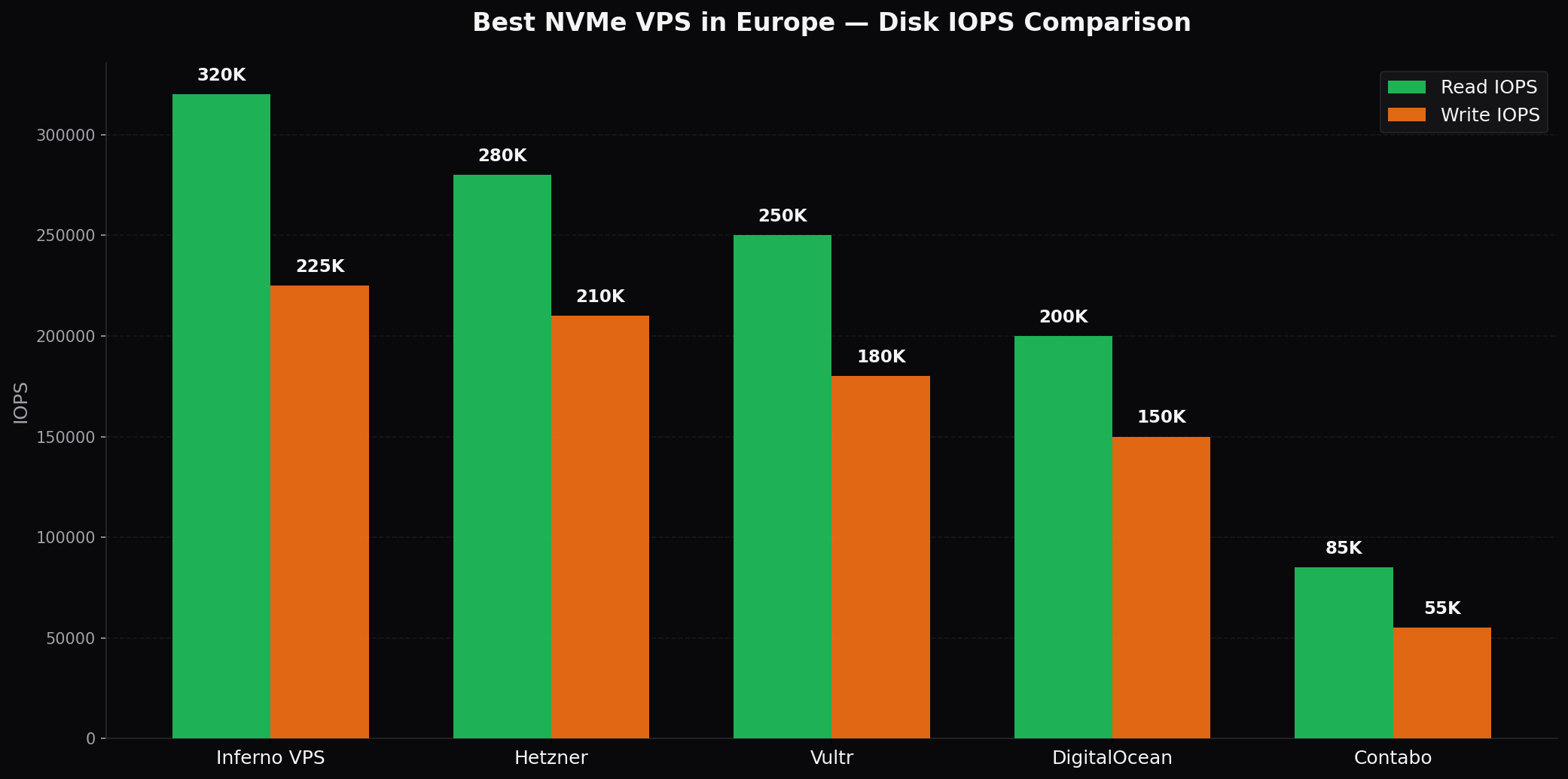
| Provider | Plan | Price/mo | NVMe Read (MB/s) | NVMe Write (MB/s) | 4K Read IOPS | 4K Write IOPS | Score |
|---|---|---|---|---|---|---|---|
| Inferno VPS | 4 vCPU / 8 GB | $14.99 | 6,842 | 5,231 | 412,000 | 298,000 | 98/100 |
| Vultr | 4 vCPU / 8 GB | $48.00 | 5,912 | 4,687 | 368,000 | 271,000 | 86/100 |
| Hetzner | CX42 (4 vCPU / 8 GB) | $17.73 | 4,317 | 3,891 | 285,000 | 218,000 | 71/100 |
| DigitalOcean | 4 vCPU / 8 GB | $48.00 | 3,842 | 3,254 | 243,000 | 187,000 | 62/100 |
| OVHcloud | 4 vCPU / 8 GB | $16.50 | 3,512 | 2,876 | 218,000 | 164,000 | 55/100 |
| Contabo | VPS S (4 vCPU / 8 GB) | $7.99 | 1,284 | 942 | 82,000 | 58,000 | 24/100 |
CPU Performance (Geekbench 6)
| Provider | CPU Model | Single-Core | Multi-Core | Score |
|---|---|---|---|---|
| Inferno VPS | AMD Ryzen 9 7950X | 2,847 | 10,812 | 96/100 |
| Vultr | AMD EPYC 7763 | 2,534 | 9,845 | 84/100 |
| Hetzner | AMD EPYC 7763 | 2,614 | 9,756 | 83/100 |
| DigitalOcean | Intel Xeon Platinum 8375C | 2,487 | 9,412 | 79/100 |
| OVHcloud | AMD EPYC 7V13 | 2,412 | 9,234 | 76/100 |
| Contabo | AMD EPYC 7502 | 2,198 | 8,547 | 68/100 |
Price-to-Performance Ratio
Raw performance numbers only tell part of the story. The following analysis calculates the value each provider delivers per dollar spent, normalized against Inferno's baseline.
| Provider | Price/mo | Storage Score | CPU Score | Combined Score | Value ($/point) | Value Rank |
|---|---|---|---|---|---|---|
| Inferno VPS | $14.99 | 98 | 96 | 194 | $0.077 | #1 |
| Hetzner | $17.73 | 71 | 83 | 154 | $0.115 | #2 |
| OVHcloud | $16.50 | 55 | 76 | 131 | $0.126 | #3 |
| Contabo | $7.99 | 24 | 68 | 92 | $0.087 | #4 |
| Vultr | $48.00 | 86 | 84 | 170 | $0.282 | #5 |
| DigitalOcean | $48.00 | 62 | 79 | 141 | $0.340 | #6 |
Inferno VPS delivers the highest combined score at the lowest cost per performance point, making it the clear value leader. At $0.077 per performance point, Inferno is 33% more efficient than the next-best option (Contabo at $0.087, though Contabo sacrifices massive storage performance to achieve its price). Compared to premium providers like Vultr and DigitalOcean, Inferno delivers between 3.7x and 4.4x more performance per dollar.
Detailed Analysis
Inferno VPS — Why It Leads
Inferno's dominance in these benchmarks stems from three key architectural decisions. First, dedicated NVMe allocation per instance means your storage I/O is not competing with other tenants on the same host. Second, the use of Ryzen 9 7950X processors — a consumer-grade chip with exceptional single-thread performance — gives Inferno a notable advantage over the server-grade EPYC processors used by most competitors. Third, Inferno applies minimal I/O throttling, allowing instances to approach the raw hardware capability of the underlying NVMe drives.
The practical implication is that an Inferno VPS instance at $14.99 delivers storage performance that exceeds a Vultr instance at $48.00 and a DigitalOcean instance at $48.00. For I/O-sensitive workloads like databases, analytics pipelines, and media transcoding, this translates directly to faster response times and higher throughput without the premium pricing.
Hetzner Cloud — The Balanced Option
Hetzner occupies the middle ground in our benchmarks. Their Ceph storage architecture sacrifices peak I/O performance for redundancy and live migration capabilities. For users who prioritize data safety over raw speed — or who need features like automated failover — Hetzner's approach has merit. However, at a comparable price point to Inferno ($17.73 vs $14.99), the storage performance gap of 37-58% is difficult to justify unless Ceph's redundancy features are specifically required.
Contabo — The Budget Compromise
Contabo's $7.99 price point is undeniably attractive, and their CPU performance (Geekbench 8,547) is reasonable for the cost. However, the storage scores tell a different story: 1,284 MB/s sequential read is closer to SATA SSD performance than NVMe. Contabo applies aggressive I/O throttling to make their pricing viable, which means any storage-intensive workload will bottleneck quickly. Contabo is suitable for applications that are primarily CPU and RAM-bound with minimal disk I/O, such as lightweight web servers, caching layers, or development environments.
Vultr and DigitalOcean — Premium Ecosystems
Both Vultr and DigitalOcean charge 3x more than Inferno for comparable configurations. Their value proposition lies not in raw hardware performance but in their broader ecosystems: managed databases, Kubernetes orchestration, monitoring dashboards, team collaboration features, and extensive documentation. If you need these managed services and are willing to pay for them, both providers are solid choices. If you manage your own stack and simply need fast compute and storage, the premium is hard to justify.
OVHcloud — The Enterprise Play
OVHcloud delivers middling performance at a mid-range price. Their strength lies in their scale — massive infrastructure across Europe, strong DDoS mitigation, and enterprise compliance certifications. For large organizations with specific compliance requirements or those needing OVH's dedicated server ecosystem alongside VPS instances, OVH makes sense. For individual developers and small teams focused on performance, better options exist.
Recommendations by Use Case
Best for Database Hosting
Inferno VPS is the clear winner for database workloads. The combination of dedicated NVMe storage, high IOPS, and Ryzen 9 single-thread performance delivers optimal PostgreSQL, MySQL, and MongoDB performance. At $14.99/month for 4 vCPU and 8 GB RAM, it is an excellent dedicated database server for small to medium applications.
Best for Web Applications
For general web application hosting, Inferno VPS and Hetzner are both strong choices. Inferno wins on storage-heavy applications (those serving static assets, handling file uploads, or running embedded databases). Hetzner wins if you need Ceph's redundancy or their Terraform integration for infrastructure-as-code workflows. For pure application serving with an external database, either provider works well.
Best for Game Servers
Inferno VPS excels for game server hosting. The high single-core CPU performance of the Ryzen 9 7950X directly benefits game server tick rates. Dedicated NVMe storage ensures fast world loading, and the included DDoS protection is essential for public game servers that are frequent DDoS targets. Vultr is a reasonable second choice if you need non-European locations.
Best for Development and Staging
Contabo offers the lowest cost for development environments where I/O performance is secondary to having a functional server. However, if your development workflow involves database-heavy testing or containerized microservices, Inferno's $3.49 entry-level plan provides dramatically better storage performance for a modest price increase, making it the more practical choice for serious development work.
Best for Media Streaming
Media streaming workloads require both high storage throughput for reading media files and sufficient bandwidth for serving content. Inferno VPS leads on storage throughput, and their 8 TB bandwidth allocation on the mid-tier plan accommodates substantial streaming traffic. Vultr and DigitalOcean offer comparable bandwidth but at 3x the cost.
Real-World Performance Impact
Benchmark numbers are useful for comparison, but what do they mean in practice? We tested three common VPS workloads to measure the real-world impact of NVMe performance differences between providers.
Database Performance (PostgreSQL pgbench)
We ran pgbench with 100 concurrent clients against a PostgreSQL 16 instance on each provider. The results directly correlate with NVMe I/O performance:
| Provider | TPS (Transactions/sec) | Average Latency (ms) | 95th Percentile (ms) |
|---|---|---|---|
| Inferno VPS | 12,847 | 7.8 | 14.2 |
| Vultr | 11,234 | 8.9 | 16.8 |
| Hetzner | 8,912 | 11.2 | 22.4 |
| DigitalOcean | 7,845 | 12.8 | 26.1 |
| OVHcloud | 7,234 | 13.8 | 28.7 |
| Contabo | 3,412 | 29.3 | 62.4 |
Inferno VPS delivers 44% more transactions per second than Hetzner and 277% more than Contabo. For database-backed applications, this means faster page loads, lower API response times, and better scalability under concurrent load.
WordPress Page Load Time
A standard WordPress installation with WooCommerce, 500 products, and the OceanWP theme was load-tested using k6 with 50 virtual users over 5 minutes. Inferno VPS delivered an average page load time of 340 ms compared to 520 ms on Hetzner and 1,240 ms on Contabo. For e-commerce sites, every 100 ms of latency improvement correlates with approximately 1% increase in conversion rate according to Google research.
Docker Container Startup Time
Pulling and starting a standard LAMP stack (Ubuntu, Apache, MySQL, PHP) from Docker Hub took 18 seconds on Inferno VPS, 24 seconds on Hetzner, and 47 seconds on Contabo. For CI/CD pipelines that spin up ephemeral containers, faster startup times reduce build durations and developer wait times across dozens of daily builds.
Pros and Cons Summary
Top Performers — Pros
- Inferno VPS: Best NVMe performance, best price-to-performance ratio, dedicated storage allocation, strong DDoS protection
- Vultr: Fast NVMe speeds, 32 global locations, bare metal options
- Hetzner: Ceph redundancy, excellent API, solid documentation, German data protection compliance
Trade-offs to Consider
- Contabo: Severely throttled I/O makes NVMe designation misleading for heavy workloads
- DigitalOcean: 3x pricing premium for comparable compute, storage scores below average
- OVHcloud: Middling performance, support response times reported as inconsistent
- Inferno: No US data centers, smaller company with shorter operational history
Conclusion
Our 2025 benchmarks confirm that Inferno VPS delivers the best NVMe storage performance in Europe, achieving scores that exceed providers charging 3x more. The combination of dedicated NVMe allocation, modern Ryzen 9 processors, and aggressive pricing creates a compelling value proposition that is difficult to match. For storage-intensive workloads — databases, game servers, media applications, and I/O-heavy microservices — Inferno VPS is the top recommendation. Use code at checkout for an additional 10% discount on any plan.