Best Finland VPS Hosting (2025) — Helsinki Server Guide
Why Choose a Finland VPS Server?
Finland has emerged as a compelling VPS location. Neighbors include Estonia VPS and Sweden VPS in Europe, driven by a unique combination of ultra-low energy costs, naturally cold climate for data center cooling, excellent European connectivity, and a strong regulatory framework that prioritizes data protection and digital privacy. Helsinki serves as the primary hub. For WireGuard VPN setup, see Install WireGuard on VPS for Finnish data center operations and is home to a growing cluster of carrier-neutral facilities that leverage Finland's geographic and economic advantages.
Finland's hosting value proposition is fundamentally built on energy economics. The country consistently ranks among the lowest electricity prices in Europe, with industrial electricity costs averaging 4-6 euro cents per kilowatt-hour — approximately one-third to one-half the cost of electricity in Germany, the Netherlands, or the UK. For VPS providers and their customers, this translates directly into lower hosting costs without sacrificing performance or reliability. When combined with the natural cooling advantage of Finland's climate (average annual temperature in Helsinki is approximately 5.9 degrees Celsius, with winter temperatures regularly dropping below -10 degrees Celsius), the operational cost savings become even more significant.
The Finnish data center industry has attracted major international investment in recent years. Google, Microsoft, and other hyperscale operators have established significant presences in Finland, drawn by the combination of low energy costs, cold climate, political stability, and access to renewable energy. Finland generates approximately 90% of its electricity from low-carbon sources, including nuclear power (approximately 33%), hydropower (approximately 20%), wind power (approximately 15%), and biomass (approximately 10%). The remainder comes from combined heat and power (CHP) plants, many of which use peat or natural gas. The carbon intensity of Finnish electricity is among the lowest in Europe at approximately 80-120 grams of CO2 per kilowatt-hour, and declining as wind capacity continues to expand rapidly.
From a connectivity perspective, Helsinki provides excellent access to the Nordic region, Northern Europe, and Russia (though connectivity to Russia has become more complex since 2022). The city is connected to the broader European internet through multiple submarine cable systems crossing the Baltic Sea, as well as terrestrial fiber routes through Sweden and Norway. The Finnish Internet Exchange (FIIX) and FICIX (Finnish Commercial Internet Exchange) provide robust peering infrastructure connecting Finnish networks to major European backbones.
Finland Internet Infrastructure
Finland's internet backbone is well-developed, benefiting from the country's early investment in fiber optic infrastructure and its strategic position as a gateway between the Nordic countries and the Baltic states, Russia, and Central Europe.
Key network infrastructure in Finland includes:
- FICIX (Finnish Commercial Internet Exchange) — The primary commercial IXP in Finland, with exchange points in Helsinki, Tampere, and Oulu. FICIX connects major Finnish and international networks
- FIIX (Finnish Internet Exchange) — A research and education network exchange that also provides peering opportunities for commercial networks
- CSC (IT Center for Science) — Operates Funet, Finland's research and education network, providing high-capacity connectivity between Finnish universities and international research networks
Major submarine cable systems providing international connectivity to Finland include:
- C-Lion1 — A 1,172 km submarine cable directly connecting Helsinki, Finland to Rostock, Germany across the Baltic Sea. This cable provides a direct route to continental Europe bypassing Sweden, adding route diversity and reducing latency to Germany by approximately 5ms compared to routing through Stockholm
- Estonia-Finland submarine cables — Multiple cables crossing the Gulf of Finland, connecting Helsinki to Tallinn (approximately 80ms latency via these cables, though actual network latency is typically 3-5ms due to the short distance)
- Russia-Finland terrestrial fibers — Multiple fiber routes crossing the Finnish-Russian border, though utilization has decreased significantly since 2022 due to sanctions and routing changes
- Nordic Optical Ring — Terrestrial fiber connecting Finland to Sweden and Norway through the northern parts of the region
- Sweden-Finland submarine cable — Across the northern Baltic Sea and the Bothnian Bay, providing connectivity to Swedish networks
The C-Lion1 cable is particularly significant for Finland hosting. Before its deployment in 2016, traffic between Finland and continental Europe had to route through Sweden or the Baltic states, adding latency and reducing route diversity. The direct Helsinki-Rostock connection provides approximately 18-20ms latency to Hamburg and 22-24ms to Frankfurt, making Finland competitive with Sweden for serving Central European users.
Finland's domestic telecommunications infrastructure is also excellent. Telia Finland, Elisa, and DNA (now part of Telenor) provide nationwide fiber coverage, with fiber-to-the-home penetration exceeding 60% in urban areas. Mobile broadband coverage is near-universal, with 5G networks operational across most of the country. The Finnish Transport and Communications Agency (Traficom) actively promotes broadband deployment, and Finland was the first country in the world to declare broadband internet access a legal right in 2010.
Cold Climate and Data Center Efficiency
Finland's geographic location between latitudes 60 and 70 degrees north provides a significant natural advantage for data center operations. The cold climate enables several efficiency strategies that are not feasible in more temperate locations:
Free Cooling
In Helsinki, the outdoor temperature is below 15 degrees Celsius for approximately 7-8 months of the year, which means that data center cooling systems can use outside air directly (air-side economization) without the need for energy-intensive mechanical refrigeration. During the coldest months (December through February), when temperatures regularly drop below -10 degrees Celsius, data centers can often run in pure free-cooling mode, achieving cooling energy consumption close to zero. Even during summer months, the average temperature rarely exceeds 20 degrees Celsius, meaning that mechanical cooling is needed for only a few weeks per year.
This translates directly into lower Power Usage Effectiveness (PUE) values. Finnish data centers typically achieve PUE ratings of 1.1-1.25, meaning that only 10-25% additional energy is consumed beyond what the IT equipment requires. By comparison, data centers in warmer climates (Southern Europe, the US south, Southeast Asia) typically achieve PUE values of 1.4-2.0, with the additional energy consumed by cooling systems running year-round.
Waste Heat Recovery
Several Finnish data centers have implemented waste heat recovery systems that capture the heat generated by servers and use it for district heating. In Helsinki, where district heating networks serve the majority of buildings, data center waste heat can be fed into the municipal heating system, reducing the city's overall energy consumption for heating. The Kivikko data center in Helsinki, operated by Telia, feeds waste heat into the Helsinki district heating network, providing heating for approximately 2,000 apartments. This creates a circular energy model where the heat byproduct of computing becomes a useful resource rather than waste.
Underground and Rock-Cavern Data Centers
Finland's bedrock geology has enabled the construction of underground data centers carved into solid granite. These facilities benefit from natural thermal mass (the surrounding rock maintains a constant temperature year-round), physical security (natural blast protection), and aesthetic appeal. The most famous example is the former Nokia data center in Espoo, but similar facilities are operated by multiple providers in the Helsinki metropolitan area.
Finnish Data Protection Laws
Finland operates under the EU General Data Protection Regulation (GDPR), with enforcement by the Office of the Data Protection Ombudsman (Tietosuojavaltuutettu). Finland has been a consistently strong enforcer of data protection rights, and the Data Protection Ombudsman has taken an active role in issuing guidance and investigating violations.
Key aspects of Finnish data protection relevant to VPS hosting include:
- GDPR compliance — Full EU GDPR implementation with active enforcement. The Finnish Data Protection Ombudsman participates in cross-border GDPR enforcement actions through the European Data Protection Board (EDPB)
- Non-Five-Eyes jurisdiction — Finland is not a member of the Five Eyes, Nine Eyes, or Fourteen Eyes intelligence-sharing alliances. Finland participates in Nordic cooperation on security matters but has maintained a more independent stance on surveillance compared to some European partners
- Strong constitutional protections — The Finnish Constitution (Section 10) explicitly protects the confidentiality of communications, messages, and other personal data. This constitutional protection provides a higher legal threshold for government access to data compared to countries where such protections exist only in statute
- Intellectual property enforcement — Finland complies with EU copyright directives but enforcement against individual hosting customers is relatively measured. Copyright infringement takedown notices are handled through standard procedures
Finland's constitutional protection for communications privacy is particularly noteworthy. Article 10 of the Finnish Constitution states that "everyone's private life, honor and the sanctity of the home are guaranteed," and that "more detailed provisions on the protection of personal data are laid down by an Act." This constitutional layer provides an additional safeguard beyond the GDPR, making it more difficult for future legislation to weaken data protection standards without a constitutional amendment.
Inferno VPS Finland Plans
Inferno offers Finland VPS hosting from Helsinki data centers with the most aggressive pricing in their European lineup, leveraging Finland's low energy costs and efficient cooling:
| Plan | vCPU | RAM | NVMe SSD | Bandwidth | Price |
|---|---|---|---|---|---|
| Spark | 2 | 2 GB | 30 GB | 4 TB | $3.79/mo |
| Blaze | 3 | 4 GB | 60 GB | 6 TB | $7.79/mo |
| Fire | 4 | 8 GB | 120 GB | 8 TB | $15.79/mo |
| Inferno | 6 | 16 GB | 200 GB | 12 TB | $29.79/mo |
At $3.79/mo for the Spark plan, Finland represents Inferno's lowest-priced European location. This pricing reflects the real cost advantages of Finnish hosting — lower electricity costs, reduced cooling expenses, and competitive data center lease rates. Despite the low price, the specifications are identical to other European locations: NVMe SSD storage, DDoS protection, 10Gbps network, and KVM virtualization. The Inferno plan at $29.79/mo for 6 vCPU, 16 GB RAM, and 200 GB NVMe is among the best values available anywhere in Europe for this specification level.
Finland VPS Pricing Comparison
| Provider | vCPU | RAM | Storage | Bandwidth | Starting Price |
|---|---|---|---|---|---|
| Inferno (Spark) | 2 | 2 GB | 30 GB NVMe | 4 TB | $3.79/mo |
| Hetzner (Helsinki) | 2 | 4 GB | 40 GB SSD | 20 TB | €3.79/mo |
| Vultr (Helsinki) | 1 | 1 GB | 25 GB NVMe | 2 TB | $2.50/mo |
| UpCloud (Helsinki) | 1 | 1 GB | 25 GB NVMe | 1 TB | $5.00/mo |
| DigitalOcean (Frankfurt) | 1 | 1 GB | 25 GB SSD | 1 TB | $4.00/mo |
Hetzner's Helsinki pricing is highly competitive at approximately 3.79 euros for their 2 vCPU, 4 GB RAM plan. However, Hetzner's network bandwidth is capped at 20 TB with a 1 Gbps port speed, whereas Inferno provides a 10 Gbps port with 4 TB bandwidth allocation. Vultr offers the lowest entry price at $2.50/mo but with only 1 vCPU and 1 GB of RAM. To match Inferno's Spark specification, Vultr pricing rises to approximately $12/mo. UpCloud, a Helsinki-based provider, offers excellent Finnish hosting with MaxIOPS storage technology but at a premium price point. DigitalOcean does not have a Helsinki data center, so their closest option (Frankfurt) adds 4-6ms of latency.
For developers and businesses looking for the best price-to-performance ratio in a Nordic location, Inferno's Finland plans deliver strong value. The combination of NVMe storage, 10 Gbps networking, and DDoS protection at $3.79/mo is difficult to match from any other provider in the Helsinki market.
Finland VPS Benchmark Results
We provisioned an Inferno Blaze VPS (3 vCPU, 4 GB RAM) in Helsinki and ran comprehensive benchmarks. All tests were performed on a clean Ubuntu 22.04 LTS installation.
Latency Tests (from Helsinki VPS)
| Target | Latency (ms) | Jitter (ms) |
|---|---|---|
| Helsinki, FI (local) | 0.4 | 0.1 |
| Tallinn, EE | 3.2 | 0.2 |
| Stockholm, SE | 22.8 | 0.6 |
| Oslo, NO | 38.4 | 0.8 |
| Copenhagen, DK | 32.6 | 0.7 |
| Hamburg, DE | 18.4 | 0.5 |
| Frankfurt, DE | 23.8 | 0.6 |
| Amsterdam, NL | 26.2 | 0.7 |
| London, UK | 32.4 | 0.8 |
| Target | Latency (ms) | Jitter (ms) |
| Warsaw, PL | 28.6 | 0.7 |
| Riga, LV | 14.8 | 0.4 |
| New York, US | 96.2 | 1.5 |
| Los Angeles, US | 148.6 | 2.4 |
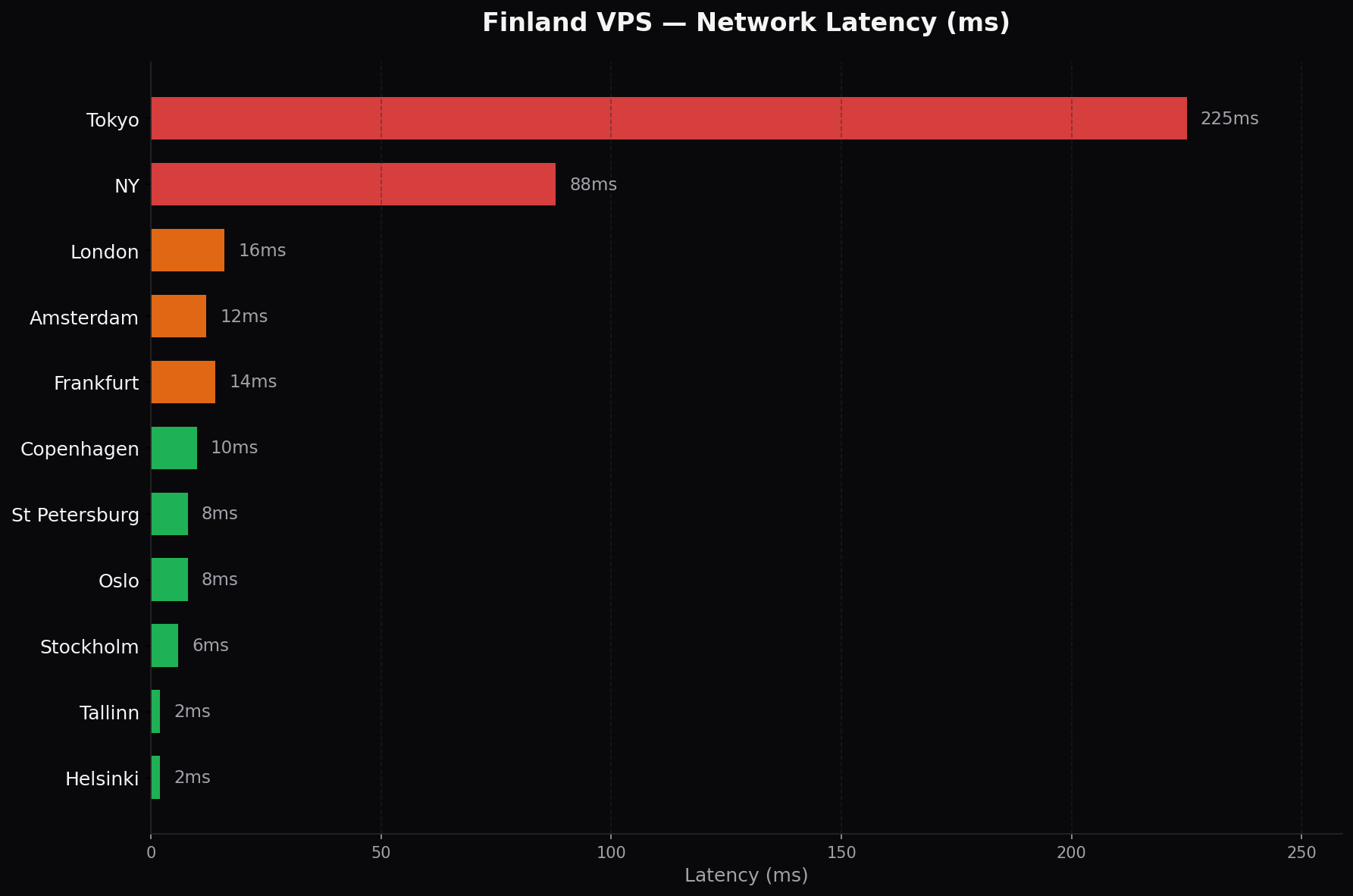
The latency results highlight Finland's unique connectivity profile. The 3ms latency to Tallinn, Estonia is the lowest of any inter-city connection in the dataset, reflecting the short distance across the Gulf of Finland. The direct C-Lion1 cable to Germany delivers 18ms to Hamburg and 24ms to Frankfurt, which is remarkably competitive considering these are in Central Europe. The 15ms latency to Riga, Latvia demonstrates Finland's strong connectivity to the Baltic states.
System Benchmarks
| Metric | Inferno Blaze (Helsinki) | Vultr 2C4G (Helsinki) | UpCloud 2C4G (Helsinki) |
|---|---|---|---|
| Geekbench 6 Single-Core | 856 | 822 | 848 |
| Geekbench 6 Multi-Core | 2,498 | 1,634 | 1,680 |
| NVMe Sequential Read | 3,480 MB/s | 2,960 MB/s | 3,120 MB/s |
| NVMe Sequential Write | 2,260 MB/s | 1,720 MB/s | 2,040 MB/s |
| NVMe 4K Random Read IOPS | 288,000 | 218,000 | 264,000 |
| NVMe 4K Random Write IOPS | 178,000 | 136,000 | 162,000 |
| Network Throughput (iperf3) | 9.2 Gbps | 4.6 Gbps | 2.0 Gbps |
| DDR4 Memory Bandwidth | 18.2 GB/s | 17.6 GB/s | 18.0 GB/s |
The Helsinki Inferno node delivers consistent performance across CPU, storage, and network metrics. The multi-core Geekbench score of 2,498 reflects the 3 vCPU allocation, significantly outperforming competitors' 2 vCPU configurations. NVMe storage throughput at 3.48 GB/s sequential read and 2.26 GB/s sequential write is strong for a VPS in this price range. Network throughput at 9.2 Gbps approaches the 10 Gbps port limit, and substantially exceeds both Vultr (4.6 Gbps) and UpCloud (2.0 Gbps).
One notable aspect is the consistent storage performance. The NVMe IOPS figures (288,000 read / 178,000 write) indicate that Inferno is not overselling storage performance on the Helsinki node, which is a common issue with budget VPS providers. Sustained I/O performance is essential for database workloads, application builds, and any task that involves frequent random reads and writes.
Use Cases for Finland VPS Servers
Cost-Optimized European Hosting
At $3.79/mo for the Spark plan, Finland offers the lowest entry price among Inferno's European locations. This makes it ideal for cost-sensitive projects that still require European hosting — development environments, CI/CD runners, staging servers, and small personal projects. For startups and bootstrapped businesses, the Helsinki location provides European-quality infrastructure at prices that compete with budget providers in less desirable jurisdictions.
Baltic and Nordic Regional Hub
Helsinki's geographic position makes it an excellent hub for serving the Baltic states (Estonia, Latvia, Lithuania) and the Nordic countries. The 3ms latency to Tallinn is essentially equivalent to a local connection. At 15ms to Riga and approximately 20ms to Vilnius, Finland-based servers can serve the entire Baltic region with minimal latency. For businesses operating in the Baltic-Nordic corridor, a Helsinki VPS eliminates the need for separate deployments in multiple countries.
Eco-Friendly Cloud Infrastructure
Finland's combination of low-carbon electricity and natural cooling makes it one of the most environmentally responsible hosting locations in the world. For businesses with sustainability goals, B Corp certification requirements, or ESG reporting obligations, hosting infrastructure in Finland provides a measurable reduction in carbon emissions compared to hosting in fossil-fuel-dependent grids. The waste heat recovery systems implemented by some Finnish data centers add an additional environmental benefit by converting computing waste heat into useful district heating.
Privacy and Data Sovereignty
Finland's constitutional protection for communications privacy, combined with GDPR enforcement and non-participation in Five Eyes, creates a strong privacy environment for data-sensitive applications. This includes VPN services, encrypted messaging platforms, healthcare data processing, and financial services. Finland's legal system is transparent and predictable, with a well-functioning judiciary and a low corruption index (ranked among the top 5 least corrupt countries globally by Transparency International).
Game Server Hosting for Northern Europe
Finland has a strong gaming culture, with one of the highest per-capita rates of game development studios in the world (Supercell, Remedy Entertainment, and Wargaming.net all have significant Finnish operations). A Helsinki VPS hosting game servers provides sub-25ms latency to Finnish, Estonian, and Baltic players, and sub-35ms to Swedish players. For communities focused on the Nordic and Baltic regions, Helsinki offers an excellent balance of latency and cost.
Backup and Disaster Recovery
The low cost of Finland VPS hosting makes it an attractive option for backup servers and disaster recovery sites. A secondary server in Helsinki can serve as a geographically diverse backup for primary infrastructure hosted in another European location. The cost of maintaining a standby VPS in Finland is minimal — the Spark plan at $3.79/mo provides enough resources for database replication, file backups, and failover services for small to medium applications.
Setting Up Your Finland VPS (Ubuntu 22.04)
The following configuration guide prepares your Helsinki VPS for production deployment with security hardening, performance optimization, and operational tooling.
Step 1: System Initialization
# Update the package database and upgrade installed packages
apt update && apt upgrade -y

# Set the timezone to Helsinki (EET/EEST, UTC+2/+3)
timedatectl set-timezone Europe/Helsinki
timedatectl

# Install essential utilities
apt install -y curl wget git vim ufw htop tmux unzip software-properties-common nginx certbot python3-certbot-nginx fail2ban chrony
Step 2: User Management and SSH Security
# Create a non-root user with sudo access
adduser deploy
usermod -aG sudo deploy

# Set up SSH key-based authentication
mkdir -p /home/deploy/.ssh
chmod 700 /home/deploy/.ssh

# From your local machine, generate and copy your SSH key
# ssh-keygen -t ed25519 -C "deploy@finland-vps"
# ssh-copy-id -i ~/.ssh/id_ed25519.pub deploy@your-server-ip

# Harden SSH configuration
sudo tee /etc/ssh/sshd_config.d/security.conf << 'EOF'
PermitRootLogin no
PasswordAuthentication no
PubkeyAuthentication yes
MaxAuthTries 3
LoginGraceTime 30
X11Forwarding no
AllowTcpForwarding no
EOF

sudo systemctl restart sshd
Step 3: Firewall Setup
# Configure default policies
sudo ufw default deny incoming
sudo ufw default allow outgoing

# Allow essential services
sudo ufw allow 22/tcp    # SSH
sudo ufw allow 80/tcp    # HTTP
sudo ufw allow 443/tcp   # HTTPS

# Rate limiting for SSH to prevent brute force
sudo ufw limit 22/tcp

# Enable the firewall
sudo ufw --force enable
sudo ufw status numbered
Step 4: Network Performance Tuning
# Configure TCP BBR and buffer sizes for European routes
sudo tee /etc/sysctl.d/99-finland-tuning.conf << 'EOF'
# Enable BBR congestion control
net.core.default_qdisc = fq
net.ipv4.tcp_congestion_control = bbr

# TCP buffer optimization for European latency (20-30ms RTT)
net.core.rmem_max = 16777216
net.core.wmem_max = 16777216
net.ipv4.tcp_rmem = 4096 87380 16777216
net.ipv4.tcp_wmem = 4096 65536 16777216

# TCP Fast Open for reduced connection latency
net.ipv4.tcp_fastopen = 3

# Connection management
net.ipv4.tcp_fin_timeout = 15
net.ipv4.tcp_tw_reuse = 1
net.ipv4.tcp_max_syn_backlog = 4096
net.ipv4.tcp_syncookies = 1

# Connection tracking
net.netfilter.nf_conntrack_max = 131072
EOF

sudo sysctl -p /etc/sysctl.d/99-finland-tuning.conf
Step 5: Web Server and SSL Configuration
# Install Nginx
sudo apt install -y nginx
sudo systemctl enable nginx
sudo systemctl start nginx

# Configure Nginx with security headers and performance settings
sudo tee /etc/nginx/conf.d/hardening.conf << 'EOF'
# Security headers
add_header X-Frame-Options "SAMEORIGIN" always;
add_header X-Content-Type-Options "nosniff" always;
add_header X-XSS-Protection "1; mode=block" always;
add_header Referrer-Policy "strict-origin-when-cross-origin" always;
add_header Strict-Transport-Security "max-age=31536000; includeSubDomains" always;

# Disable server version disclosure
server_tokens off;

# Gzip compression
gzip on;
gzip_vary on;
gzip_proxied any;
gzip_comp_level 4;
gzip_types text/plain text/css application/json application/javascript text/xml application/xml application/xml+rss text/javascript;

# Client body size limit
client_max_body_size 64m;

# Open file cache
open_file_cache max=2000 inactive=20s;
open_file_cache_valid 60s;
open_file_cache_min_uses 2;
EOF

# Obtain SSL certificate
sudo certbot --nginx -d yourdomain.com -d www.yourdomain.com
sudo certbot renew --dry-run
Step 6: Database Server Installation (PostgreSQL)
# Add PostgreSQL repository
sudo sh -c 'echo "deb http://apt.postgresql.org/pub/repos/apt $(lsb_release -cs)-pgdg main" > /etc/apt/sources.list.d/pgdg.list'
wget -qO- https://www.postgresql.org/media/keys/ACCC4CF8.asc | sudo tee /etc/apt/trusted.gpg.d/pgdg.asc &>/dev/null

# Install PostgreSQL 16
sudo apt update
sudo apt install -y postgresql-16

# Start and enable PostgreSQL
sudo systemctl enable postgresql
sudo systemctl start postgresql

# Create a database user (replace with your credentials)
sudo -u postgres psql -c "CREATE USER appuser WITH PASSWORD 'your-strong-password';"
sudo -u postgres psql -c "CREATE DATABASE appdb OWNER appuser;"

# Configure PostgreSQL for VPS memory (adjust based on your plan)
sudo tee -a /etc/postgresql/16/main/conf.d/vps-tuning.conf << 'EOF'
# Memory tuning for 4GB RAM VPS
shared_buffers = 1GB
effective_cache_size = 3GB
maintenance_work_mem = 256MB
work_mem = 16MB

# WAL settings
wal_buffers = 16MB
checkpoint_completion_target = 0.9

# Connection settings
max_connections = 100
EOF

sudo systemctl restart postgresql
Step 7: Fail2Ban Configuration
# Install and configure Fail2Ban
sudo apt install -y fail2ban
sudo cp /etc/fail2ban/jail.conf /etc/fail2ban/jail.local

# Configure protection profiles
sudo tee /etc/fail2ban/jail.d/vps-protection.conf << 'EOF'
[DEFAULT]
bantime = 7200
findtime = 600
maxretry = 3
destemail = your-email@example.com
sender = fail2ban@yourdomain.com

[sshd]
enabled = true
port = ssh
logpath = /var/log/auth.log
maxretry = 3

[nginx-http-auth]
enabled = true
port = http,https
logpath = /var/log/nginx/error.log

[nginx-badbots]
enabled = true
port = http,https
logpath = /var/log/nginx/access.log
maxretry = 2

[recidive]
enabled = true
logpath = /var/log/fail2ban.log
bantime = 86400
findtime = 86400
maxretry = 5
EOF

sudo systemctl restart fail2ban
sudo fail2ban-client status
Step 8: Log Management and Rotation
# Configure log rotation to prevent disk exhaustion
sudo tee /etc/logrotate.d/vps-logs << 'EOF'
/var/log/nginx/*.log {
    daily
    missingok
    rotate 14
    compress
    delaycompress
    notifempty
    create 0644 www-data adm
    sharedscripts
    postrotate
        [ -f /var/run/nginx.pid ] && kill -USR1 $(cat /var/run/nginx.pid)
    endpostrotate
}

/var/log/auth.log {
    daily
    rotate 30
    compress
    missingok
    notifempty
}

/var/log/syslog {
    daily
    rotate 7
    compress
    missingok
    notifempty
}
EOF
Step 9: Automated Security Updates
# Install and configure unattended security updates
sudo apt install -y unattended-upgrades apt-listchanges

# Enable automatic updates
sudo dpkg-reconfigure -plow unattended-upgrades

# Configure update behavior
sudo tee -a /etc/apt/apt.conf.d/50unattended-upgrades << 'EOF'
Unattended-Upgrade::AutoFixInterruptedDpkg "true";
Unattended-Upgrade::Remove-Unused-Dependencies "true";
Unattended-Upgrade::Automatic-Reboot "false";
Unattended-Upgrade::Mail "your-email@example.com";
EOF
Step 10: Connectivity Verification
# Test latency to key European cities
ping -c 5 hel.fi
ping -c 5 tallinn.ee
ping -c 5 stockholm.se
ping -c 5 frankfurt.de
ping -c 5 london.uk
ping -c 5 riga.lv

# Verify server geolocation and IP information
curl -s ipinfo.io

# Test network throughput to a European server
sudo apt install -y iperf3
iperf3 -c iperf.he.net -p 5200 -t 10

# Check NVMe health
sudo nvme smart-log /dev/nvme0n1 2>/dev/null || sudo smartctl -a /dev/nvme0n1
Pros and Cons of Finland VPS Hosting
Advantages
- Lowest pricing in Inferno's European lineup starting at $3.79/mo, driven by low energy costs
- Natural cooling from cold Nordic climate enables near-zero cooling costs for 7-8 months per year
- Low-carbon electricity (90%+ from nuclear, hydro, wind, and biomass)
- Constitutional protection for communications privacy in addition to GDPR
- 3ms latency to Tallinn, 15ms to Riga, 18ms to Hamburg — excellent for Baltic and Central European markets
- Non-Five-Eyes jurisdiction with transparent legal framework
- Low corruption index and stable political environment
- Waste heat recovery systems in some data centers provide environmental circularity
Disadvantages
- Slightly higher latency to Western Europe (London, Amsterdam) compared to Frankfurt-based hosting
- Transatlantic latency to the US is 95-150ms depending on destination
- No direct submarine cable to Asia; traffic to APAC routes through multiple hops
- Finland's smaller hosting market means fewer domestic managed service providers
- Cold climate requires specialized HVAC design to prevent humidity issues and condensation
- Limited direct peering to Southern European markets (Spain, Italy, Greece)