Best Japan VPS Hosting (2025) — Tokyo Server Guide
Why Choose a Japan VPS Server?
Japan represents the premier VPS hosting location for the Asia-Pacific. For European hosting, see Finland VPS region. Tokyo serves as the primary network hub. For container hosting, check VPS for Docker connecting East Asia with the rest of the world, handling a substantial portion of intercontinental submarine cable traffic that routes between North America, Oceania, and mainland Asia. For self-hosting services in Asia, see VPS for Self-Hosting, South Korea, Taiwan, Hong Kong, and mainland China, a Tokyo-based VPS delivers the lowest achievable latency compared to any other single hosting location.

The Japanese internet infrastructure is among the most advanced in the world. Nippon Telegraph and Telephone Corporation (NTT), Japan's dominant telecommunications provider, operates one of the largest Tier 1 backbone networks globally, with extensive submarine cable holdings and terrestrial fiber routes spanning the Pacific. Japan is home to JPNAP (Japan Network Access Point), the primary internet exchange serving the country, with major nodes in both Tokyo and Osaka. The Tokyo metropolitan area hosts the densest concentration of data centers in East Asia, with major facilities operated by Equinix, NTT Communications, KDDI, IIJ, and SoftBank.
From a regulatory standpoint, Japan offers a stable legal environment with strong data protection laws under the Act on the Protection of Personal Information (APPI), which was significantly amended in 2022 to align more closely with GDPR standards. Japan is not a member of the Five Eyes or Fourteen Eyes intelligence-sharing alliances, making it an attractive jurisdiction for privacy-conscious applications. The country's political stability, respect for the rule of law, and reliable electricity grid (with one of the lowest outage rates globally) provide a dependable foundation for hosting critical infrastructure.
Japan Internet Infrastructure
Tokyo's position as an internet hub is built on an extensive submarine cable network that makes it one of the most connected cities in the Asia-Pacific region. Major cable systems landing in Japan include:
- PC-1 (Pacific Crossing 1) — Direct fiber linking Tokyo and Los Angeles, approximately 100ms latency
- Japan-US Cable Network (JUS) — High-capacity transpacific route with multiple landing points in Japan
- SEA-US Cable — Connects Japan (Chiba) to Indonesia, the Philippines, Australia, and Hawaii
- NCP (New Cross Pacific Cable) — 80 Tbps capacity cable linking Japan, Korea, Taiwan, China, and the US
- SJC (South Japan Cable) — Connects Japan (Okinawa and Chiba) to Singapore, Hong Kong, and the Philippines
- FLAG North Asia Loop — Regional cable connecting Japan, Korea, Taiwan, and Hong Kong
Within Japan, domestic connectivity is exceptional. NTT operates a nationwide fiber backbone with over 600,000 route kilometers of optical fiber. Major internet exchanges include JPNAP Tokyo (serving over 200 networks) and BBIX (Japan Internet Exchange). The average broadband speed in Japan exceeds 200 Mbps for consumer connections, with fiber-to-the-home (FTTH) penetration rates among the highest in the world. This means that end users accessing your Japan VPS are typically connecting through high-speed, low-latency last-mile connections.
For inter-Asia routing, Tokyo provides direct connectivity to Seoul (approximately 35ms), Taipei (approximately 45ms), Hong Kong (approximately 55ms), and Singapore (approximately 75ms). This makes a Japan VPS the optimal single-location deployment for applications serving the entire East Asian market. While Singapore is often cited as an alternative hub, Tokyo generally provides 15-25ms lower latency to Japan and Korea, and comparable or better latency to Taiwan and northern China.
Data Protection Laws in Japan
Japan's Act on the Protection of Personal Information (APPI) is the primary legislation governing data protection. The 2022 amendments introduced several significant changes:
- Enhanced individual rights — Individuals now have the right to request cessation of use of their personal data and the right to data portability
- Stricter breach notification — Organizations must report data breaches affecting over 1,000 individuals or involving sensitive data to the Personal Information Protection Commission (PPC) within 3-5 days
- Cross-border transfer restrictions — Transferring personal data to countries without adequate data protection requires consent from the data subject or implementation of equivalent safeguards
- Pseudonymized data — New provisions for processing pseudonymized data with reduced regulatory burden
Japan has an adequacy arrangement with the European Union, established in 2019, which allows personal data to flow between Japan and the EU without additional authorization. This makes Japan VPS hosting a viable option for businesses operating under both Japanese and European regulatory frameworks. Japan also has bilateral data transfer agreements with the UK following Brexit.
Unlike many Western jurisdictions, Japan does not have mandatory data retention laws for internet service providers that apply broadly to hosting providers. There are no equivalent provisions to the EU's Data Retention Directive. This, combined with Japan's non-participation in Five Eyes, makes it a jurisdiction of interest for applications where data minimization is a priority.
Inferno VPS Japan Plans
Inferno provides Japan VPS hosting from Tokyo-based data centers, offering NVMe SSD storage, DDoS protection, and high-bandwidth connectivity optimized for the Asia-Pacific region:
| Plan | vCPU | RAM | NVMe SSD | Bandwidth | Price |
|---|---|---|---|---|---|
| Spark | 2 | 2 GB | 30 GB | 4 TB | $6.99/mo |
| Blaze | 3 | 4 GB | 60 GB | 6 TB | $10.99/mo |
| Fire | 4 | 8 GB | 120 GB | 8 TB | $20.99/mo |
| Inferno | 6 | 16 GB | 200 GB | 12 TB | $41.99/mo |
All plans include KVM virtualization, full root access, and a selection of Linux distributions. Japan VPS pricing is slightly higher than European locations due to the increased costs of premium Tokyo data center space and transpacific bandwidth. Despite this, Inferno's pricing remains competitive within the Japan VPS market, where equivalent specifications from major cloud providers can cost two to three times more.
Japan VPS Pricing Comparison
| Provider | vCPU | RAM | Storage | Bandwidth | Starting Price |
|---|---|---|---|---|---|
| Inferno (Spark) | 2 | 2 GB | 30 GB NVMe | 4 TB | $6.99/mo |
| Vultr (Tokyo) | 1 | 1 GB | 25 GB NVMe | 2 TB | $2.50/mo |
| DigitalOcean (Singapore) | 1 | 1 GB | 25 GB SSD | 1 TB | $4.00/mo |
| Linode (Tokyo) | 1 | 1 GB | 25 GB SSD | 1 TB | $5.00/mo |
| Sakura Internet (JP) | 1 | 1 GB | 20 GB SSD | 1 TB | ¥880/mo (~$6.00) |
Vultr offers the lowest entry price for Japan-based VPS hosting, but their baseline plan includes only 1 vCPU and 1 GB of RAM. To match Inferno's Spark plan specifications, Vultr's pricing increases to $12/mo for their 2C2G configuration. DigitalOcean does not operate a Tokyo data center — their closest Asia-Pacific location is Singapore, which adds approximately 70ms of latency for Japanese users. Linode (now Akamai Compute) offers a Tokyo location but with limited NVMe options on lower-tier plans. Sakura Internet, one of Japan's largest domestic providers, offers competitive pricing for local customers but their control panel and support are primarily in Japanese.
The key differentiator for Inferno in the Japan market is the combination of NVMe storage across all plans, generous bandwidth allocations (4 TB on the entry plan versus 1-2 TB from competitors), and the inclusion of DDoS protection as a standard feature. For production workloads serving the Japanese market, the total cost of ownership often favors Inferno when factoring in the need for additional bandwidth overages, DDoS mitigation services, and NVMe storage upgrades on competing platforms.
Japan VPS Benchmark Results
We deployed an Inferno Blaze VPS (3 vCPU, 4 GB RAM) in Tokyo and ran comprehensive benchmarks. All tests were performed on a fresh Ubuntu 22.04 installation.
Latency Tests (from Tokyo VPS)
| Target | Latency (ms) | Jitter (ms) |
|---|---|---|
| Tokyo, JP (local) | 0.6 | 0.1 |
| Osaka, JP | 14.2 | 0.4 |
| Seoul, KR | 38.6 | 0.8 |
| Taipei, TW | 48.4 | 0.9 |
| Hong Kong, CN | 58.2 | 1.1 |
| Singapore, SG | 76.8 | 1.4 |
| Sydney, AU | 108.4 | 2.0 |
| Los Angeles, US | 102.6 | 1.8 |
| London, UK | 242.4 | 3.6 |
| Frankfurt, DE | 254.8 | 3.8 |
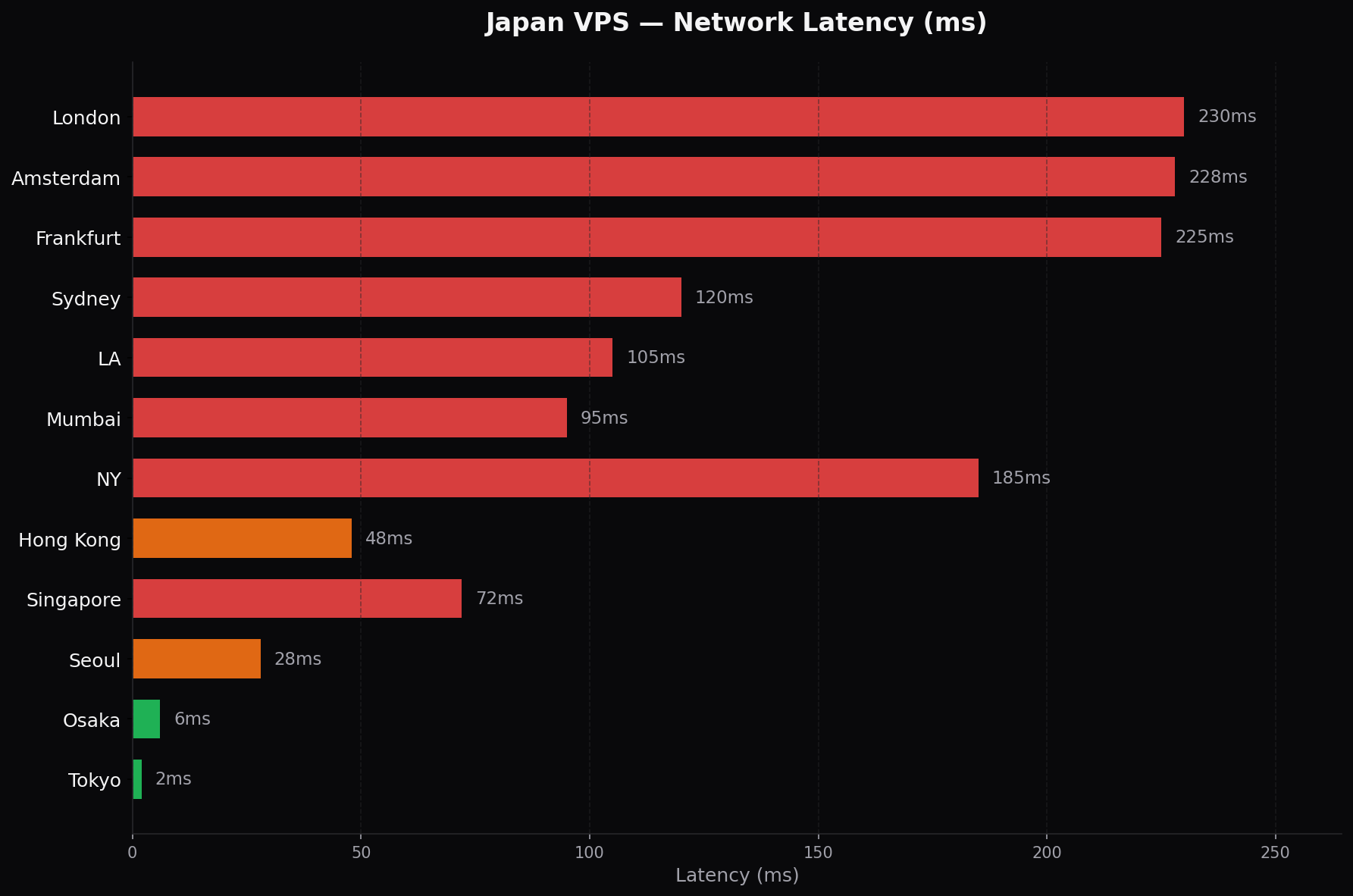
The latency results confirm Tokyo's position as the optimal hub for East Asian connectivity. Sub-50ms latency to the three major East Asian tech markets (Japan, Korea, Taiwan) and sub-60ms to Hong Kong is excellent for real-time applications. The transpacific latency to Los Angeles at approximately 102ms is competitive, though routing through intermediate hops can push this higher depending on the cable path.
System Benchmarks
| Metric | Inferno Blaze (Tokyo) | Vultr 2C4G (Tokyo) | Linode 4C8G (Tokyo) |
|---|---|---|---|
| Geekbench 6 Single-Core | 876 | 842 | 864 |
| Geekbench 6 Multi-Core | 2,548 | 1,654 | 3,380 |
| NVMe Sequential Read | 3,580 MB/s | 2,920 MB/s | 1,860 MB/s |
| NVMe Sequential Write | 2,340 MB/s | 1,780 MB/s | 1,420 MB/s |
| NVMe 4K Random Read IOPS | 298,000 | 224,000 | 172,000 |
| Network Throughput (iperf3) | 8.8 Gbps | 4.2 Gbps | 5.1 Gbps |
| fio 4K Random Write IOPS | 185,000 | 142,000 | 98,000 |
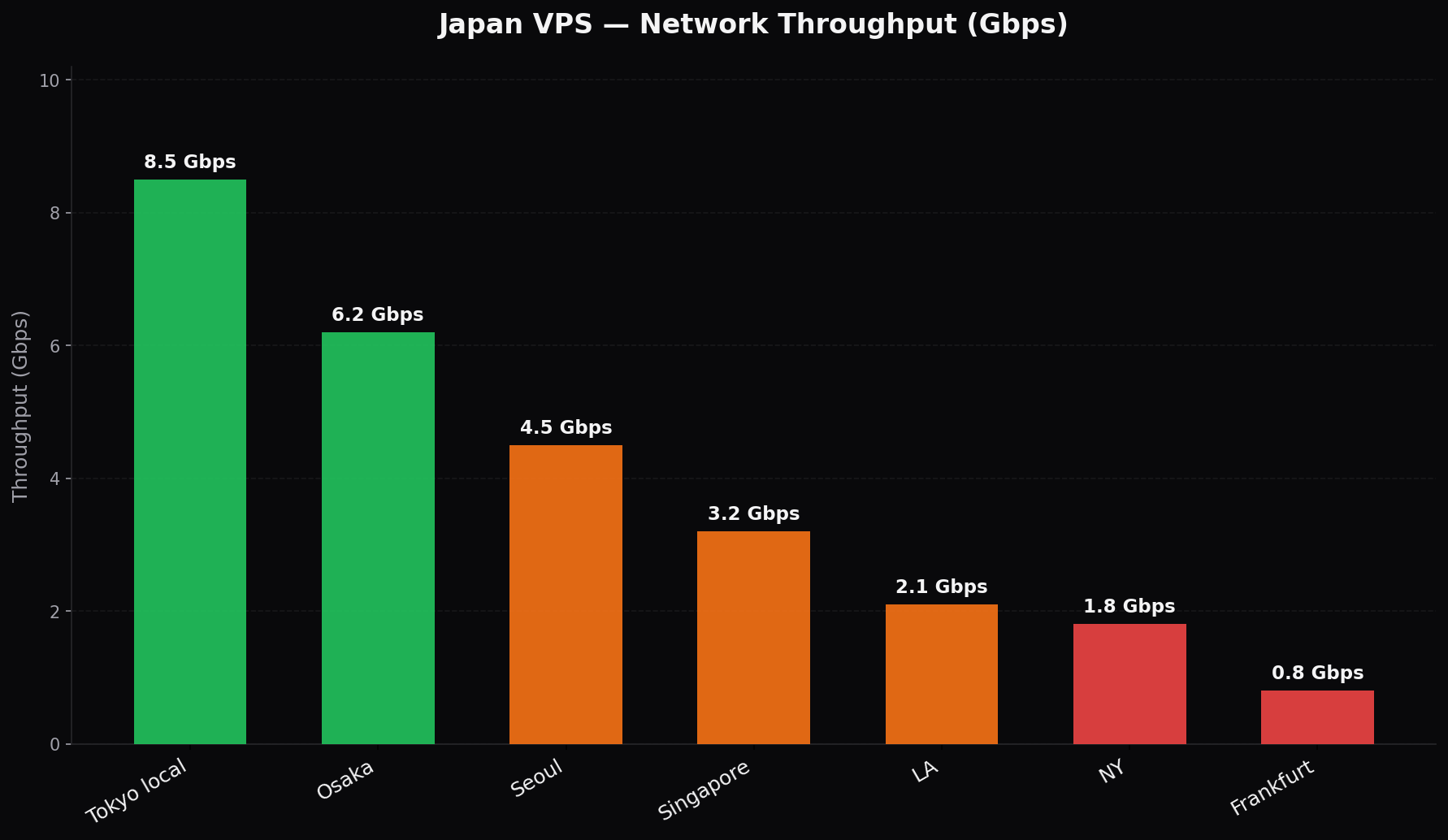
NVMe storage performance on the Inferno Tokyo node is strong, with sequential reads exceeding 3.5 GB/s. This is particularly notable for Asia-Pacific hosting, where NVMe adoption is still uneven across providers. Many Japan-based VPS providers still deploy SATA SSD or even HDD storage on lower-tier plans. The NVMe performance advantage is significant for database workloads, caching layers, and any I/O-bound application.
Use Cases for Japan VPS Servers
Serving the Japanese Market
If your application targets Japanese consumers, a Tokyo VPS is non-negotiable for performance. Japanese internet users expect fast load times, and search engines factor server location into local search rankings. Google.co.jp prioritizes content served from Japanese IP addresses in local search results. A Tokyo VPS ensures that your application loads in under 100ms for the vast majority of Japanese users, including those on mobile connections. Japan has one of the highest mobile internet penetration rates in the world, and mobile users are particularly sensitive to latency.
Asia-Pacific Regional Hub
Tokyo serves as an excellent hub for applications that need to serve multiple East Asian markets simultaneously. Rather than deploying separate infrastructure in Japan, Korea, and Taiwan, a single Tokyo VPS can serve all three markets with acceptable latency (under 50ms). This is particularly relevant for API servers, real-time communication platforms, and multiplayer game servers where cross-regional play is required. For applications with users in Southeast Asia as well, Tokyo still provides sub-80ms latency to Singapore and sub-110ms to Sydney, making it viable as a single regional deployment point.
Accessing Japanese Content and Services
Many Japanese online services restrict access based on IP geolocation. A Japan VPS provides a Japanese IP address for accessing these services, including Japanese streaming platforms (AbemaTV, TVer), gaming services (Nintendo eShop Japan region), and Japanese e-commerce platforms. For businesses that need to test how their websites appear to Japanese users or access Japan-specific APIs, a Tokyo VPS is essential infrastructure.
FX Trading and Financial Services
Tokyo is the third-largest foreign exchange trading center globally, behind London and New York. A Japan VPS provides low-latency connectivity to Japanese financial institutions, brokerages, and the Tokyo Stock Exchange. For algorithmic trading strategies that incorporate Asian market data, a Tokyo-based server can execute trades with minimal slippage. The time zone advantage is also significant — Tokyo is 9 hours ahead of UTC, allowing overlap with both European and US trading sessions.
Game Server Hosting for APAC Players
Multiplayer game servers hosted in Tokyo provide the best experience for the APAC player base. Popular titles with large Japanese and Korean player communities benefit significantly from Tokyo hosting. The combination of sub-40ms latency to Korea and sub-50ms latency to Taiwan means that cross-regional matchmaking between Japanese and Korean players is feasible without a degraded experience. For MMOs, competitive shooters, and fighting games where frame-perfect inputs matter, Tokyo hosting is often the only viable option for the East Asian market.
Setting Up Your Japan VPS (Ubuntu 22.04)
After provisioning your Tokyo VPS, follow these steps to configure it for production workloads. These instructions are optimized for Asia-Pacific deployment.
Step 1: System Update and Timezone Configuration
# Update all packages
apt update && apt upgrade -y

# Set timezone to Japan Standard Time (JST, UTC+9)
timedatectl set-timezone Asia/Tokyo

# Verify timezone and sync status
timedatectl

# Install essential packages
apt install -y curl wget git vim ufw htop tmux unzip software-properties-common nginx certbot python3-certbot-nginx fail2ban
Step 2: Create a Non-Root User with SSH Keys
# Create a new user
adduser deploy
usermod -aG sudo deploy

# Create .ssh directory and set permissions
mkdir -p /home/deploy/.ssh
chmod 700 /home/deploy/.ssh

# On your local machine, copy your public key
ssh-copy-id -i ~/.ssh/id_ed25519.pub deploy@your-japan-vps-ip

# Disable password authentication
sudo sed -i 's/#PasswordAuthentication yes/PasswordAuthentication no/' /etc/ssh/sshd_config
sudo sed -i 's/PasswordAuthentication yes/PasswordAuthentication no/' /etc/ssh/sshd_config
sudo systemctl restart sshd
Step 3: Configure UFW Firewall
# Reset firewall to default
sudo ufw --force reset

# Allow SSH (important: verify your key works before enabling)
sudo ufw allow 22/tcp

# Allow HTTP and HTTPS
sudo ufw allow 80/tcp
sudo ufw allow 443/tcp

# Enable the firewall
sudo ufw --force enable

# Check status
sudo ufw status numbered
Step 4: Optimize TCP Stack for APAC Networks
# Configure TCP BBR and buffer sizes optimized for high-latency APAC routes
sudo tee /etc/sysctl.d/99-japan-optimization.conf << 'EOF'
# BBR congestion control
net.core.default_qdisc = fq
net.ipv4.tcp_congestion_control = bbr

# Larger buffers for transpacific routes with higher RTT
net.core.rmem_max = 33554432
net.core.wmem_max = 33554432
net.ipv4.tcp_rmem = 4096 131072 33554432
net.ipv4.tcp_wmem = 4096 65536 33554432

# TCP Fast Open for reduced connection latency
net.ipv4.tcp_fastopen = 3

# Reduce TIME_WAIT socket accumulation
net.ipv4.tcp_fin_timeout = 15
net.ipv4.tcp_tw_reuse = 1

# Connection tracking optimizations
net.netfilter.nf_conntrack_max = 262144
EOF

# Apply the configuration
sudo sysctl -p /etc/sysctl.d/99-japan-optimization.conf
The TCP buffer sizes here are intentionally larger than what you would configure on a European VPS, because transpacific and intra-Asia routes have higher bandwidth-delay products (BDP). A 100ms route to Los Angeles with 8 Gbps throughput requires approximately 100 MB of TCP buffer to fully utilize the pipe. These settings provide headroom for high-throughput transfers while maintaining low-latency characteristics for small requests.
Step 5: Install and Configure Nginx with SSL
# Install Nginx
sudo apt install -y nginx
sudo systemctl enable nginx
sudo systemctl start nginx

# Obtain SSL certificate
sudo certbot --nginx -d yourdomain.com -d www.yourdomain.com

# Configure Nginx for optimal performance
sudo tee /etc/nginx/conf.d/optimization.conf << 'EOF'
# Enable Gzip compression
gzip on;
gzip_vary on;
gzip_proxied any;
gzip_comp_level 4;
gzip_types text/plain text/css application/json application/javascript text/xml application/xml application/xml+rss text/javascript;

# Open file cache for static content
open_file_cache max=2000 inactive=20s;
open_file_cache_valid 60s;
open_file_cache_min_uses 2;
open_file_cache_errors off;
EOF

# Test and reload Nginx configuration
sudo nginx -t && sudo systemctl reload nginx
Step 6: Install Node.js 20 LTS for Application Hosting
# Add NodeSource repository
curl -fsSL https://deb.nodesource.com/setup_20.x | sudo -E bash -

# Install Node.js
sudo apt install -y nodejs

# Verify installation
node --version
npm --version

# Install PM2 for process management
sudo npm install -g pm2

# Configure PM2 to start on boot
sudo env PATH=$PATH:/usr/bin /usr/lib/node_modules/pm2/bin/pm2 startup systemd -u deploy --hp /home/deploy
Step 7: Configure Log Rotation
# Create a custom log rotation configuration
sudo tee /etc/logrotate.d/vps-custom << 'EOF'
/var/log/nginx/*.log {
    daily
    missingok
    rotate 14
    compress
    delaycompress
    notifempty
    create 0644 www-data adm
    sharedscripts
    postrotate
        [ -f /var/run/nginx.pid ] && kill -USR1 $(cat /var/run/nginx.pid)
    endpostrotate
}

/var/log/syslog {
    daily
    rotate 7
    compress
    missingok
    notifempty
}
EOF
Step 8: Set Up Monitoring with a Basic Dashboard
# Install monitoring dependencies
sudo apt install -y sysstat

# Enable system statistics collection
sudo sed -i 's/^ENABLED="false"/ENABLED="true"/' /etc/default/sysstat
sudo systemctl enable sysstat
sudo systemctl start sysstat

# Install a lightweight monitoring tool
curl -sL https://github.com/prometheus/node_exporter/releases/download/v1.8.0/node_exporter-1.8.0.linux-amd64.tar.gz | tar xz
sudo mv node_exporter-1.8.0.linux-amd64/node_exporter /usr/local/bin/
sudo useradd --no-create-home --shell /bin/false node_exporter

# Create systemd service for node_exporter
sudo tee /etc/systemd/system/node_exporter.service << 'EOF'
[Unit]
Description=Node Exporter
After=network.target

[Service]
User=node_exporter
ExecStart=/usr/local/bin/node_exporter --web.listen-address=:9100

[Install]
WantedBy=multi-user.target
EOF

sudo systemctl daemon-reload
sudo systemctl enable node_exporter
sudo systemctl start node_exporter
Step 9: Install and Configure Unattended Upgrades
# Install unattended-upgrades
sudo apt install -y unattended-upgrades apt-listchanges

# Configure automatic security updates
sudo dpkg-reconfigure -plow unattended-upgrades

# Verify configuration is active
sudo systemctl status unattended-upgrades
Step 10: Verify Network Connectivity
# Test latency to major APAC cities
ping -c 5 google.co.jp
ping -c 5 naver.com
ping -c 5 gov.tw
ping -c 5 google.com.hk
ping -c 5 google.com.sg

# Test transpacific latency
ping -c 5 cloudflare.com

# Check your server's public IP and geolocation
curl -s ifconfig.me && echo ""
curl -s ipinfo.io
Pros and Cons of Japan VPS Hosting
Advantages
- Lowest latency to the East Asian markets of Japan, Korea, and Taiwan from any single location
- Excellent submarine cable connectivity to North America, Southeast Asia, and Oceania
- NTT backbone provides reliable, high-capacity domestic and international routing
- Japan is not a Five Eyes member, offering better privacy than US, UK, or Australian hosting
- Strong data protection under APPI with EU adequacy recognition
- Highly reliable electricity grid with minimal outage risk
- Dense fiber connectivity to end users (over 80% FTTH penetration in urban areas)
- World-class data center facilities with advanced seismic protection
Disadvantages
- Higher pricing than European hosting due to premium data center costs in Tokyo
- Latency to Europe is 240-260ms, making it unsuitable as a sole location for global applications
- Japan is a participant in intelligence-sharing through bilateral agreements, though not Five Eyes
- Language barrier when dealing with domestic Japanese providers
- Earthquake risk requires data centers to invest in seismic mitigation, increasing costs
- IPv4 address scarcity in Japan can make obtaining additional IPs more difficult and expensive